From Post-Humanity to Human-Centred Artificial Intelligence
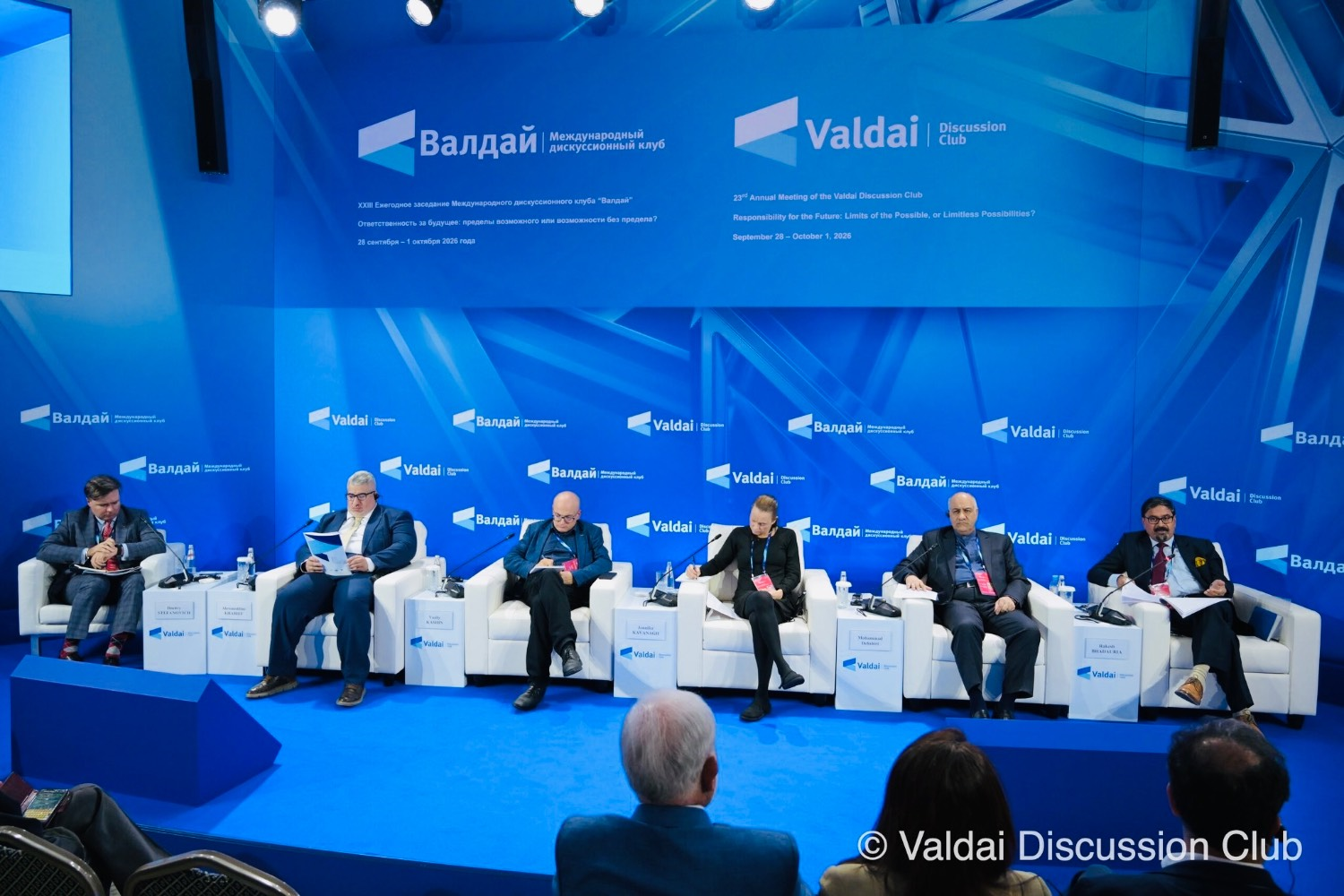
Dr. Mohammad Reza Dehshiri Dean of the School of International Relations of the Iranian Ministry of Foreign Affairs has authored an opinion piece entitled “From Post-Humanity to Human-Centred Artificial Intelligence” for the 23rd Annual meeting of the Valdai Discussion Club and is published on the Valdi Discussion Club website. The full article is available here for reading.
The transformation of warfare through artificial intelligence (AI), autonomous systems, drones, precision-guided weapons, surveillance technologies and increasingly sophisticated targeting systems has generated profound ethical questions. Yet the central challenge is not technological in itself. It concerns the future of humanity and, more specifically, the place of the human being within the decision-making processes of war. The fundamental question is therefore: What happens to humanity when technology becomes capable of identifying, classifying, tracking and potentially eliminating human beings without the attacker ever seeing them? This question points to a deeper danger than artificial intelligence: artificial inhumanity. The ethical challenge of the new war is not simply whether machines can become more accurate, autonomous or intelligent, but whether human beings can retain moral responsibility and empathy as warfare becomes increasingly technological and remote.
From the Human Being to the Target
For centuries, warfare remained a profoundly human activity. Soldiers encountered other soldiers, commanders relied on human intelligence, and decisions to employ force theoretically involved judgment concerning their consequences. Contemporary warfare increasingly transforms this relationship. The human being can become data, pattern, probability, threat classification, target and ultimately object of destruction.
This represents what may be described as the datafication of human life. An individual can be reduced to an identity, location, behavioural pattern or threat score. The ethical danger lies in the possible disappearance of the human being as a moral subject from the process of decision-making.
The technological chain of contemporary warfare can increasingly be represented as: Detect, Identify, Classify, Predict, Prioritise, Target and finally Strike. Each stage may be technologically sophisticated, but technological sophistication does not automatically produce moral sophistication. Consequently, four distinctions are essential: technical precision is not ethical precision; accuracy is not justice; automation is not responsibility; and technological superiority is not moral superiority. The central question is therefore not simply ‘Can the machine hit the target?’ It is ‘Should the target be attacked, and who remains responsible for the consequences?’
Minab: When Technology Meets Childhood
The tragedy of Minab provides one of the starkest illustrations of this dilemma. On February 28, 2026, the Shajareh Tayyebeh school in Minab, Iran was struck during the opening phase of the conflict. Three US missiles struck the school on the first day of US-Israeli aggression against Iran. 168 people were killed, including approximately 120 students and 26 teachers and staff members. The United States remains chiefly responsible for this human tragedy. One ethical principle must remain clear: a child is never merely a targeting statistic; a school is never simply a geographical coordinate; and a classroom is never merely a structure.
Behind every casualty figure there is a name, a family and a human story. The destruction of the Minab school therefore raises a fundamental question about technologically mediated warfare: When a targeting system identifies an object, does it still adequately recognise the human beings who are present? If technology advances faster than our capacity to recognise human dignity, technological progress risks becoming ethical regression.
Kuhestak: When War Enters Civilian Life
A second example is the strike near a wedding gathering in Kuhestak, southern Iran, on September 1, 2026. The incident killed at least six people, including a four-year-old child, and injured at least 68 others. The damage was consistent with a direct hit by a US munition. US officials claimed that American forces had conducted strikes in the area against military infrastructure and that the circumstances were under investigation. The ethical significance of this case lies partly in the contrast between the human meaning of the location and its possible military representation. A wedding symbolises family, love, continuity and hope. Yet within a technologically mediated battlespace, a civilian gathering may become merely a location within a targeting environment.
The machine sees coordinates; the family sees a wedding. The machine calculates probabilities; the mother sees her child. The machine identifies patterns; the community experiences grief. This illustrates why humanitarian ethics must remain superior to technological efficiency.
Gaza and the Normalisation of Suffering
The experience of Gaza represents another dimension of the ethical crisis of contemporary warfare. Beyond competing political and legal interpretations, the humanitarian principle should be universal: human dignity cannot possess a nationality. A Palestinian child does not possess less human dignity than an Israeli child; an Iranian civilian does not possess less dignity than an American civilian. Civilian suffering must not become morally invisible because its victims belong to the perceived “other side”.
The deeper danger is the normalisation of suffering. When images of dead children become routine, displacement becomes merely a statistic, hunger becomes an instrument of war, and the destruction of civilian infrastructure becomes normalised in daily reporting, the ethical boundaries of war are progressively weakened. The problem is therefore not only physical destruction. It is the gradual normalisation of inhumanity itself.
IRIS Dena: Technological Distance and Moral Distance
The case of the Iranian frigate IRIS Dena presents a distinct and deeply troubling ethical problem. On March 4, 2026, the Dena, as an unarmed naval vessel engaged in a training and educational mission, which had participated in the peaceful, ceremonial and multinational International Milan 2026 Exercise, was attacked by a US submarine in international waters off the coast of Sri Lanka. The Dena was operating without an escort or significant defensive equipment and was carrying a complement of 136 personnel. Of these, 104 were killed, including 20 who remain missing and unaccounted for. A further 32 crew members were wounded, rescued, and subsequently treated at a hospital in Sri Lanka.
Consequently, its legal and ethical status as a potential military objective is under question. The incident raises an important question concerning technologically remote warfare: The unarmed Dena destroyer was carrying out a training-oriented, peace-focused, and symbolic mission. The mission was intended to demonstrate Iran’s maritime capabilities, commitment to peace, and spirit of naval cooperation.
What happens when an attacker can destroy a vessel from a great physical distance without ever seeing the human beings aboard it? The attacker may perceive a naval signature, semi-military classification and geographical position. But the vessel is also occupied by civilian sailors who are sons, fathers, brothers and members of families. The technological distance between attacker and target must never become a moral distance. Indeed, the farther technology takes the attacker from the battlefield, the greater the need for conscious human responsibility.
From “Human-in-the-Loop” to “Humanity-in-Command”
Much contemporary debate emphasises the principle of the human-in-the-loop. Yet this concept may be insufficient. A human being can remain technically present while merely approving an algorithmic recommendation. What is required is a transition from human-in-the-loop to humanity-in-command. This means preserving genuine human moral agency: the capacity to question an automated recommendation, reject it, override it and stop the use of force when circumstances demand it.
The crucial question is therefore not simply whether a human remains somewhere within the technological chain. It is whether human beings genuinely command technology or gradually become subordinate to technological systems.
Ten Principles for Humanising the New War
A human-centred ethics of warfare should rest on ten principles:
- Humanity before military efficiency: the efficiency of destruction cannot become the ultimate measure of technological success.
- Meaningful human control: lethal decisions must remain subject to genuine human judgment.
- A presumption against autonomous lethal action: uncertainty should strengthen, rather than weaken, the requirement for human intervention.
- Humanity Impact Assessment: states should assess the foreseeable effects of autonomous and AI-enabled weapons on civilians and human dignity.
- Minimisation of foreseeable harm: military necessity cannot become an unlimited justification for civilian suffering.
- Human-centred AI: technological innovation should seek not only greater military effectiveness but also the reduction of human suffering.
- Preservation of human judgment: operators must retain the capacity to question, override and terminate automated processes.
- Independent investigation and accountability: serious allegations of unlawful civilian harm require credible investigation.
- Empathy in security policy: security calculations must incorporate human dignity, compassion and solidarity.
- Strong international regulation: the international community must strengthen legal and normative frameworks governing autonomous and AI-enabled weapons before effective human control is lost.
Conclusion: From Artificial Intelligence to Human-Centred Intelligence
The ultimate challenge of the new war is not simply the creation of artificial intelligence. It is the creation of human-centred intelligence—intelligence that asks not only ‘Can we do this?’ but ‘Should we do this?’ It asks not only whether a target can be identified, but what human consequences will follow. It asks not merely whether a weapon can destroy a target with greater precision, but whether destruction can be avoided altogether.
The cases of Minab, Kuhestak, Gaza and the IRIS Dena reveal different dimensions of the same ethical dilemma. Minab reminds us of the vulnerability of children. Kuhestak demonstrates how war can enter the most intimate spaces of civilian life. Gaza warns against the normalisation of suffering. Dena illustrates how technological distance can separate the attacker physically from the civilian human beings affected by an attack.
These cases lead to a common conclusion: technology can increase physical distance, but it must never eliminate moral responsibility. The future of warfare will therefore depend not only on how intelligent machines become, but on whether human beings remain morally intelligent. The objective should not be to reject technology, but to humanise it; not to eliminate intelligence, but to give intelligence an ethical direction; and not to remove human beings from decisions concerning life and death, but to place human dignity at the centre of those decisions.
The fundamental principle of the ethics of the new war can therefore be stated simply:
Technology may determine how a weapon reaches its target; humanity must determine whether that target should ever be attacked. Ultimately, the future of warfare should not be a future in which machines become better at killing human beings. It should be a future in which human beings become better at preventing killing.